AI is reshaping dentistry from the exam chair to the back office, improving diagnostic accuracy, enabling personalized treatment plans, and streamlining clinic operations, while human dentists remain firmly in the decision-making seat.
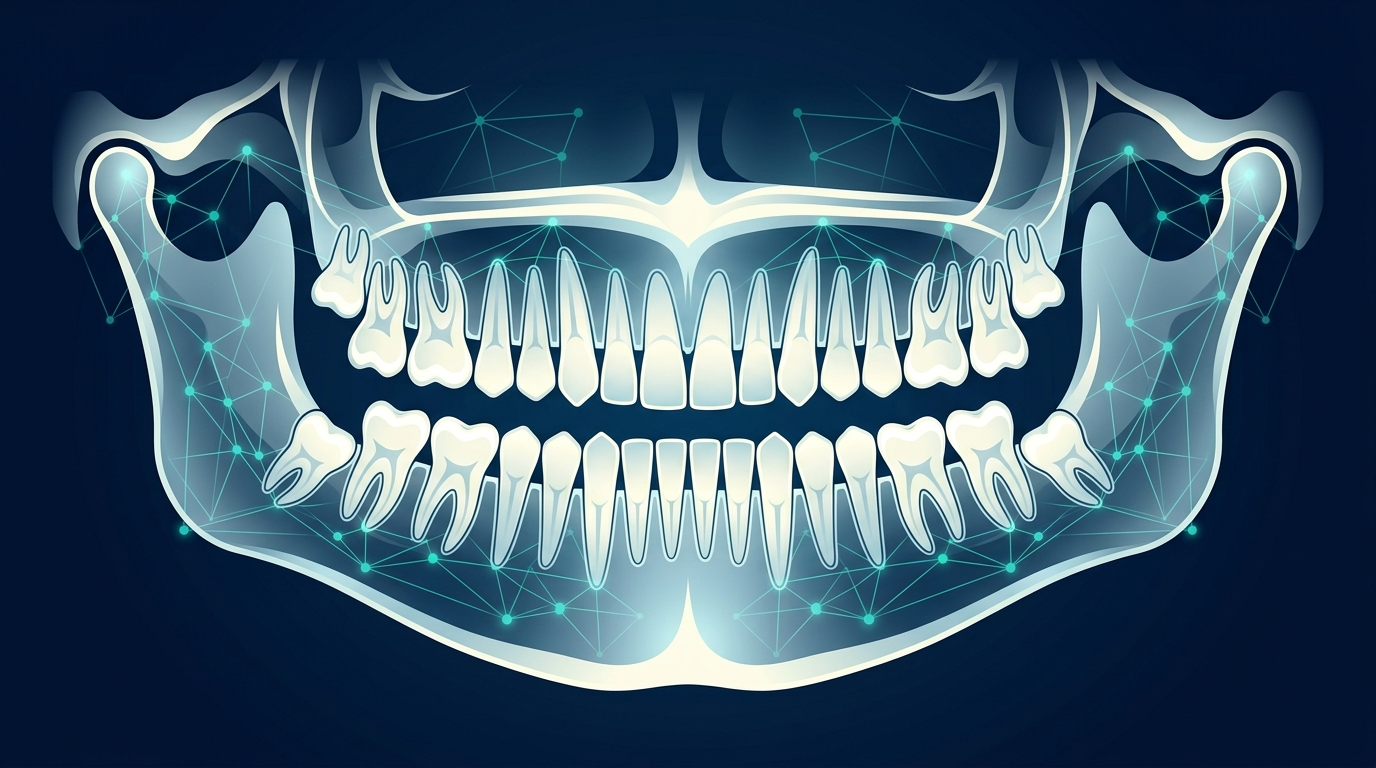
The Quiet Revolution Happening in Your Dentist's Office
Most people don't think much about what happens between the moment their X-ray is taken and when the dentist walks in to deliver news. That gap (a few minutes at most) is quietly being transformed by artificial intelligence.
AI has moved well past the experimental stage in dentistry. It's now embedded across specialties including radiology, orthodontics, periodontics, and implantology, handling tasks that range from spotting early-stage cavities to predicting treatment outcomes [1]. The breadth is striking: this isn't a single niche tool, it's a platform shift touching nearly every corner of the discipline [3].
Why does this moment matter? Two reasons. First, dental disease remains staggeringly undertreated, problems that could be caught early routinely aren't, often because human pattern recognition has real limits under clinical conditions. Second, the technology has finally caught up with the ambition. Machine learning models trained on millions of radiographs can now flag pathologies with accuracy that rivals, and in some cases exceeds, experienced clinicians [7].
For patients, that means fewer missed diagnoses. For practitioners, it means a smarter second opinion that never gets tired. And for the broader healthcare system, it means a specialty that has long operated in relative isolation from digital health trends is now at the frontier.
The most immediate (and most validated) application is diagnostic imaging. That's where we'll go next.
Seeing What the Human Eye Misses: AI-Powered Diagnostics
The diagnostic case for AI in dentistry is hard to argue with. Human dentists, even excellent ones, miss things: early-stage cavities hiding between teeth, subtle bone loss patterns, lesions that don't yet look like lesions. AI imaging systems are closing that gap in meaningful ways.
These tools analyze radiographs, CT scans, and intraoral photos to flag pathologies that might not trigger concern for another year or two under traditional review. Researchers at Harvard have highlighted AI's particular promise in spotting early-stage oral cancers, where early detection dramatically improves survival outcomes [8]. That's not a marginal improvement, that's the difference between a straightforward intervention and a serious prognosis.
The precision gains extend across routine diagnostics too. AI systems are now consistently detecting cavities, periodontal bone loss, and calculus buildup with accuracy that meets or exceeds human benchmarks [4]. Platforms like Overjet layer AI analysis directly onto existing X-ray workflows, highlighting areas of concern and even quantifying bone levels, giving dentists annotated images rather than raw films to interpret [5].
The key nuance here: AI flags, humans decide. These systems are functioning as a second set of highly trained eyes, not a replacement for clinical judgment. But a second set of eyes that never gets tired, never has a bad day, and has been trained on millions of radiographs is genuinely valuable.
The downstream effect is earlier interventions, fewer missed diagnoses, and stronger documentation for insurance and treatment discussions. Next up: how that diagnostic data is being used to build treatment plans that actually fit the individual patient.
Personalized Treatment Plans at Machine Speed
Diagnosis is only half the battle. Once a problem is identified, the real complexity begins: designing a treatment path that accounts for a patient's age, bone density, gum health, bite mechanics, medical history, and personal preferences, all at once. This is exactly where machine learning earns its keep.
AI systems can now ingest a patient's full clinical profile (imaging, charting history, medical records, risk factors) and generate customized treatment recommendations in minutes rather than the hours of analysis that would traditionally fall on the dentist [4]. For orthodontics, this means more precise aligner sequencing based on individual tooth movement predictions. For implant planning or oral surgery, AI can model bone structure and simulate outcomes before a single incision is made [2].
The personalization angle matters more than it might seem. Generic treatment protocols are built for the average patient, who doesn't actually exist. A 45-year-old diabetic with periodontal disease and a teeth-grinding habit has a fundamentally different risk profile than the textbook case, and AI systems can weight those variables in ways that would take a clinician significant time to manually integrate [5].
That said, these systems are recommendation engines, not replacement dentists. The output is a proposed plan; the dentist reviews, adjusts, and approves. Think of it like Spotify's Discover Weekly, algorithmically generated, human-curated before it ships.
The net effect: faster planning cycles, more individualized care, and dentists spending less time on data synthesis and more time on the judgment calls that actually require them. Next up, that efficiency logic extends to the parts of dentistry patients rarely see.
Beyond the Chair: AI in Scheduling, Insurance, and Teledentistry
The clinical wins get the headlines, but the operational grind is where most dental practices quietly lose time and money. AI is increasingly handling that grind.
On the administrative side, AI-powered scheduling systems can predict no-shows, optimize appointment slots, and automatically follow up with patients who are overdue for care [5]. Insurance claim processing (historically a slow, error-prone back-and-forth between practices and payers) is being compressed dramatically. AI tools can review claims against payer policies, flag documentation gaps before submission, and accelerate reimbursement cycles that used to take weeks [5]. For DSOs managing hundreds of locations, that kind of automation compounds fast.
Patient engagement is getting smarter too. Chatbots and AI-driven communication tools can answer common questions, send reminders, and guide patients through pre-appointment instructions, reducing front desk burden without sacrificing the touchpoint [5].
Then there's teledentistry, which may be the highest-stakes application of the bunch. AI-assisted remote consultations can help reach patients in rural or underserved communities who don't have reasonable access to in-person care [8]. A patient can submit photos of a concerning area; AI flags urgency, a dentist reviews remotely, and a care pathway begins, without anyone driving two hours to a clinic.
The throughline here is access and efficiency, not replacement. AI handles the repetitive; humans handle the judgment. That division of labor works well in the back office, but as we'll see in the next section, it gets more complicated when the algorithm starts bumping against the true limits of what it can know.
The Limits of the Algorithm: What AI Still Can't Do
The hype around AI in dentistry is real, but so are the guardrails. For all its diagnostic promise, AI systems are only as good as the data they're trained on, and dentistry has a chronic shortage of large, diverse, high-quality datasets [1]. Most models have been trained on radiographs from specific populations or equipment types, which raises genuine questions about how well they generalize across different patient demographics and imaging systems [8].
Regulatory friction compounds the problem. The FDA approval pathway for AI-based diagnostic tools is still maturing, which means many systems operate in a gray zone, useful as decision-support, but not yet cleared for autonomous clinical determinations [6]. That's not necessarily a bad thing. It's an appropriate speed bump for technology that directly affects patient health.
Then there's the judgment gap. AI can flag a suspicious lesion on an X-ray, but it can't factor in a patient's anxiety, their financial situation, their pain tolerance, or the ten years of context a dentist carries about that person's mouth [6]. Clinical reasoning is holistic in a way that pattern-matching, however sophisticated, isn't [1]. Harvard researchers studying AI diagnostic tools have noted that human oversight remains essential, the tools improve accuracy alongside dentists, not instead of them [8].
The honest framing: AI in dentistry is a powerful co-pilot, not an autopilot. The practices that will get the most out of these tools are the ones that treat them as a second opinion worth considering, not an oracle worth obeying.